Stella Nuova
Building a luxury e-commerce presence for a new fine jewelry brand
- Role
- Design, development, brand strategy, operations consulting
- Timeline
- Built in a 15-day sprint, refined over 3 months of async revision cycles (Dec 2025 — Mar 2026)
- Stack
- Shopify (Dawn theme, heavily customized), Liquid, vanilla JS, CSS custom properties
- Result
- A launch-ready storefront, three purchasing models, and a complete operational handoff — built so the founders never need to call a developer.
Context: From Intake to Vision
Stella Nuova is a fine jewelry brand founded by two partners in Southwest Florida. One founder’s family roots in the jewelry industry trace back to Massachusetts in the early 1970s — five decades of craftsmanship, trust, and client relationships.
Before any code was written, I ran a structured discovery survey to force clarity on scope, audience, budget, and technical expectations. The brand’s positioning came back clear — Cartier and Tiffany as reference points, fine jewelry standards across the catalog. The catalog itself was the harder problem: a product variation matrix in the hundreds of thousands, far more than any storefront could carry, which forced hard cuts at every stage. The founders’ brand instincts and product knowledge gave the project a strong foundation to build from.
The scope settled into: a luxury Shopify storefront spanning three distinct purchasing models, with a complete operational handoff so the founders could run it themselves.
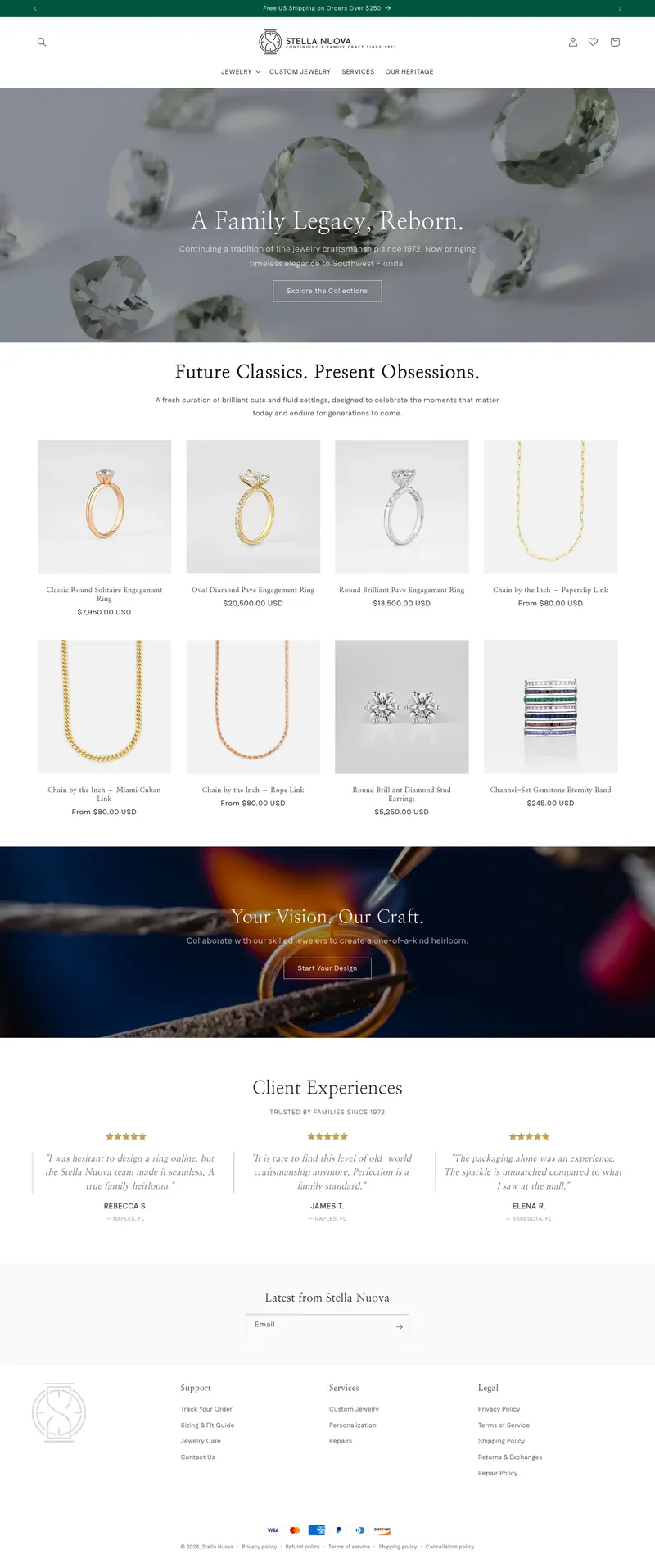
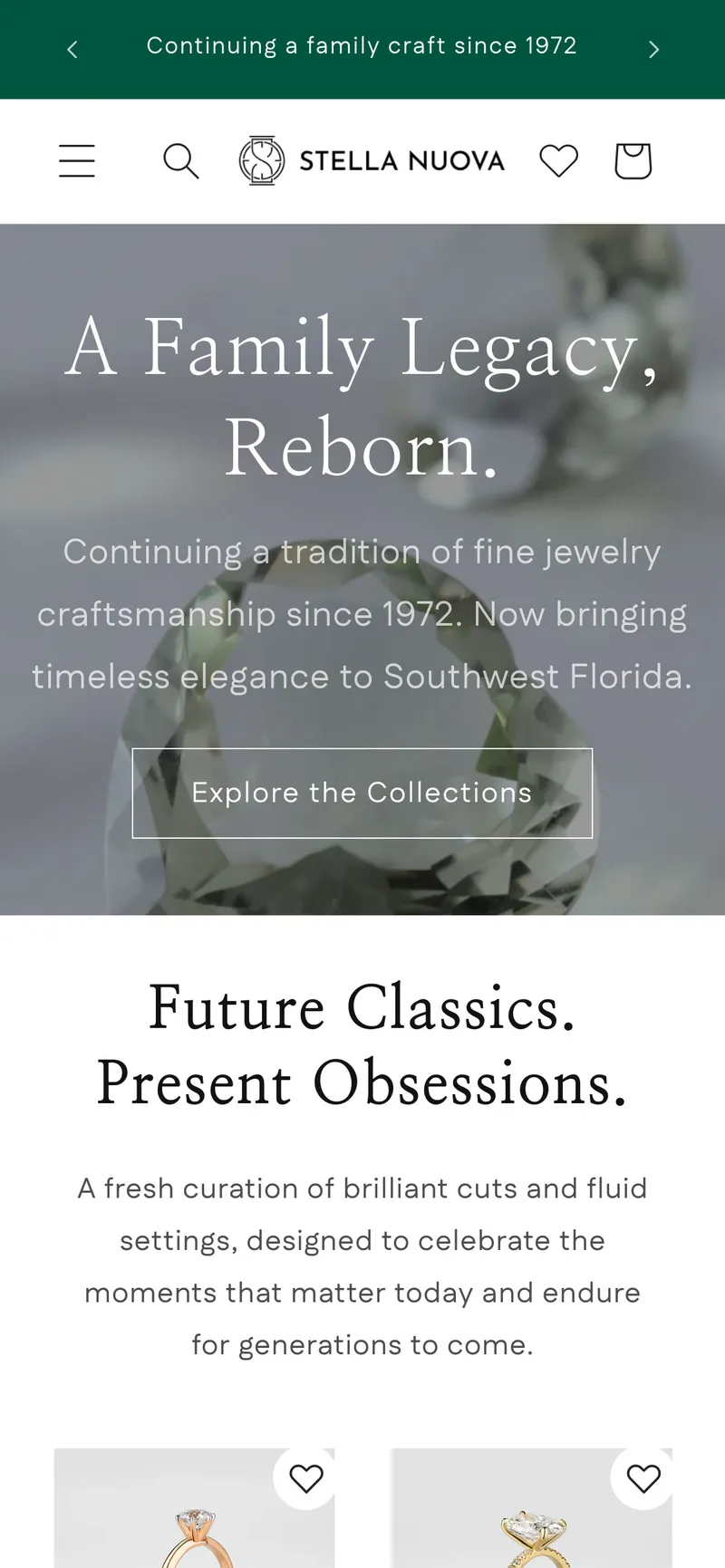
The Starting Point
The brand had strong foundations but no digital infrastructure:
- The project started from zero — no website, no product photography pipeline, no system for managing inventory. Everything that existed lived in phones, inboxes, and conversations.
- Their catalog didn’t fit a single purchasing model. A ready-to-wear ring sells differently than a chain cut to custom length, and both sell differently than a bespoke commission. Each needed its own checkout logic.
- The existing policy language came from a family jewelry store that operated with handshakes and paper forms — layaway terms, repair disclaimers, gemstone liability caps — none of it written for e-commerce.
One question had outsized consequences for the entire project: photography. The founders had a professional light box and multiple camera options, including a newer iPhone that was producing strong results. The question wasn’t whether to invest in equipment — they already had — it was which workflow would produce the most consistent, professional output.
I recommended A/B testing the iPhone against their other cameras inside the light box, and evaluating the results on a desktop monitor rather than a phone screen — phone screens hide imperfections that show up the moment a customer browses on a laptop. For a brand positioning itself alongside Cartier and Tiffany, the Cartier look is 90% photography and 10% web design. Getting this right mattered more than any section I could build.
The Insight: Concierge Over Configuration
Fine jewelry has more axes of variation — prong style, setting method, stone origin, band width by tenths of a millimeter — than any e-commerce configurator can reasonably capture. Some brands surface a fraction online. The trade-off is that every variant a configurator exposes is a decision the jeweler doesn’t get to be part of.
For Stella Nuova, that trade-off ran the wrong way. The jeweler is the product. The brand’s competitive advantage is the relationship — talking to a client, understanding what the piece is for, guiding the design personally. A configurator would have automated away the very thing customers come to them for.
The solution was a concierge model: a structured inquiry form that captures the client’s vision (budget, metals, stones, timeline, inspiration) and starts a conversation. The transaction happens through Shopify’s Draft Orders — no product listing needed, just a personal invoice sent when the piece is ready.
The most strategically complex part of the site has the simplest customer-facing flow — and the result is a client experience that aligns with how luxury jewelry actually sells.
Navigating Two Visions
The two founders brought complementary strengths — one focused on product and operations, the other on brand vision and customer experience. Both were deeply invested, and as the project moved forward we worked toward a shared framework for sorting in-scope work from post-launch initiatives.
Any new e-commerce launch surfaces a wide spectrum of questions in the same breath. A product catalog decision like “chain by the inch — regular Miami Cuban, Diamond Miami Cuban, Rope, Wheat, Box” sits naturally alongside something like “heat map tracking.” One is a today decision; the other is a conversation about post-launch analytics strategy. Both are worth having — they just belong on different timelines.
My approach was structured triage. When a longer wishlist arrived mid-project, I responded with a categorized breakdown: what was already done, what fit within the current scope, what Shopify handles natively that the founders could configure themselves, and what belonged in a genuine post-launch phase — with rationale for each. For the post-launch items, I explained what each tool actually does, why it needs live traffic data to be useful, and what it would cost to implement properly.
The shared framework gave both sides a common language for scoping decisions going forward.
The Solution
Three Purchasing Models, One Storefront
Most Shopify stores sell one way. This one needed three.
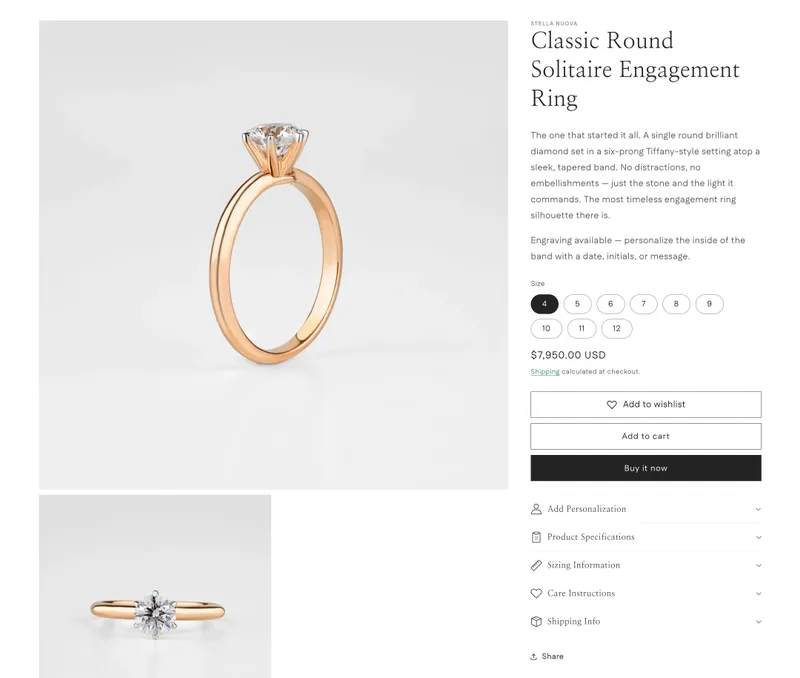
Ready-to-wear follows a standard e-commerce flow — browse, select options (ring size, metal type, engraving), checkout. The difference is in presentation: product pages use expandable accordion sections to keep the layout clean while making specifications, sizing, shipping, and care instructions accessible without clutter. I chose accordions over tabs because jewelry shoppers tend to read linearly, and accordions preserve that flow while keeping the page visually minimal.
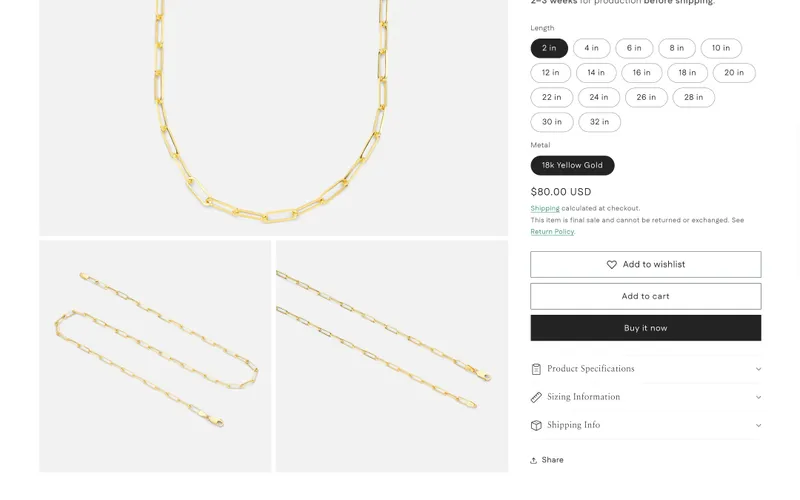
Chain-by-the-inch is made-to-order by nature — five chain styles with inch-based length options from 2” to 32”. The key design decision here was surfacing the “made to order” and “final sale” notices prominently on the product page rather than burying them in policy pages. For a made-to-order product, the moment of clarity needs to happen before checkout.
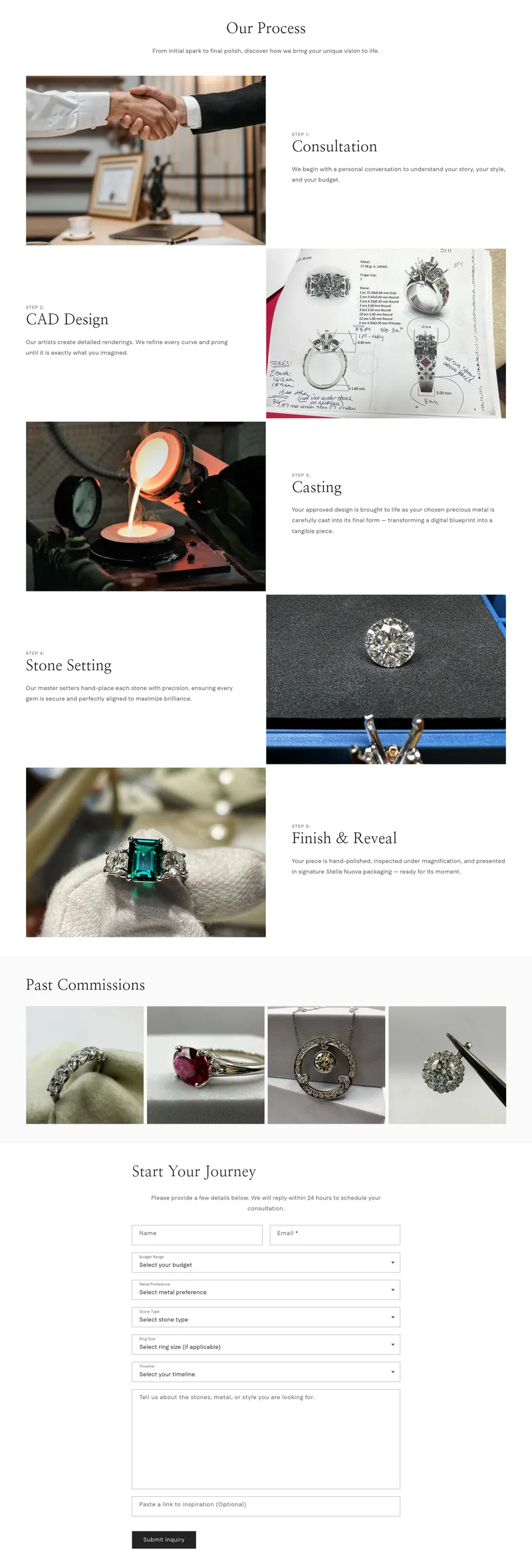
Bespoke custom jewelry uses the concierge model described above. A dedicated page walks clients through the five-stage process (Consultation, CAD Design, Casting, Stone Setting, Finish & Reveal) and collects structured inquiry data. No configurator. No checkout flow. A well-designed intake that starts a human conversation.
Where the Plan and the Platform Diverged
Part of the job was identifying where the business plan and the platform didn’t align.
One such gap appeared around secured shipping. The plan called for a signature-required option at 1.5% of order value — but Shopify doesn’t support percentage-based shipping rates. There’s no checkout field for it. Without catching this, the published shipping policy would have promised a service the platform couldn’t deliver. I designed a manual workflow using Draft Orders and documented it in the operations guide so the option could be offered without a gap between what the site promises and what it can do.
From Massachusetts Storefront to Florida E-Commerce
Beyond shipping, the founders’ inherited policies covered layaway, repair disclaimers, gemstone liability caps, a $35 flat NSF fee, and a 60-day abandonment window for unclaimed repairs. These were carried forward from a long-running in-person practice with physical signatures — the kind of language that holds up over decades at a counter, and naturally needs more than find-and-replace when it crosses a state line and a medium at the same time.
A few specifics stood out. The repair abandonment policy cited 60 days — but research into Florida’s jewelry-specific statute (F.S. 715.065) revealed the legally required minimum is one year, with mandatory written notice at intake and certified mail before disposal. The flat $35 NSF fee sat above Florida’s tiered statutory caps for checks under $300 (F.S. 68.065). And repair services themselves are taxable in Florida — labor, materials, engraving, stone work — easy to miss when the original terms were written under a different state’s tax framework.
These are the kinds of details worth catching before launch rather than after. I flagged each with specific statute references and recommended a Florida attorney review the final policy suite before going live.
The result is a complete policy suite — shipping, returns, repair, terms of service, care guide — drafted from the founders’ own terms, restructured for online commerce, and pressure-tested against Florida consumer protection law.
Compliance as a Front-End Problem
Florida requires retailers with a no-refund policy to disclose it at the point of sale (F.S. 501.142). The statute was written for physical signage, but the principle applies online. The question was where and how to surface that disclosure in the checkout flow without plastering a blanket disclaimer on every product page.
The answer was a conditional notice system tied to the product’s return eligibility. Made-to-order items are always final sale, so the notice renders server-side based on a product tag. But engravable products are a harder case — a standard ring is returnable until the customer requests engraving, at which point it becomes final sale. The notice needed to respond to user input in real time: visible when the engraving field has text, hidden when it’s cleared.
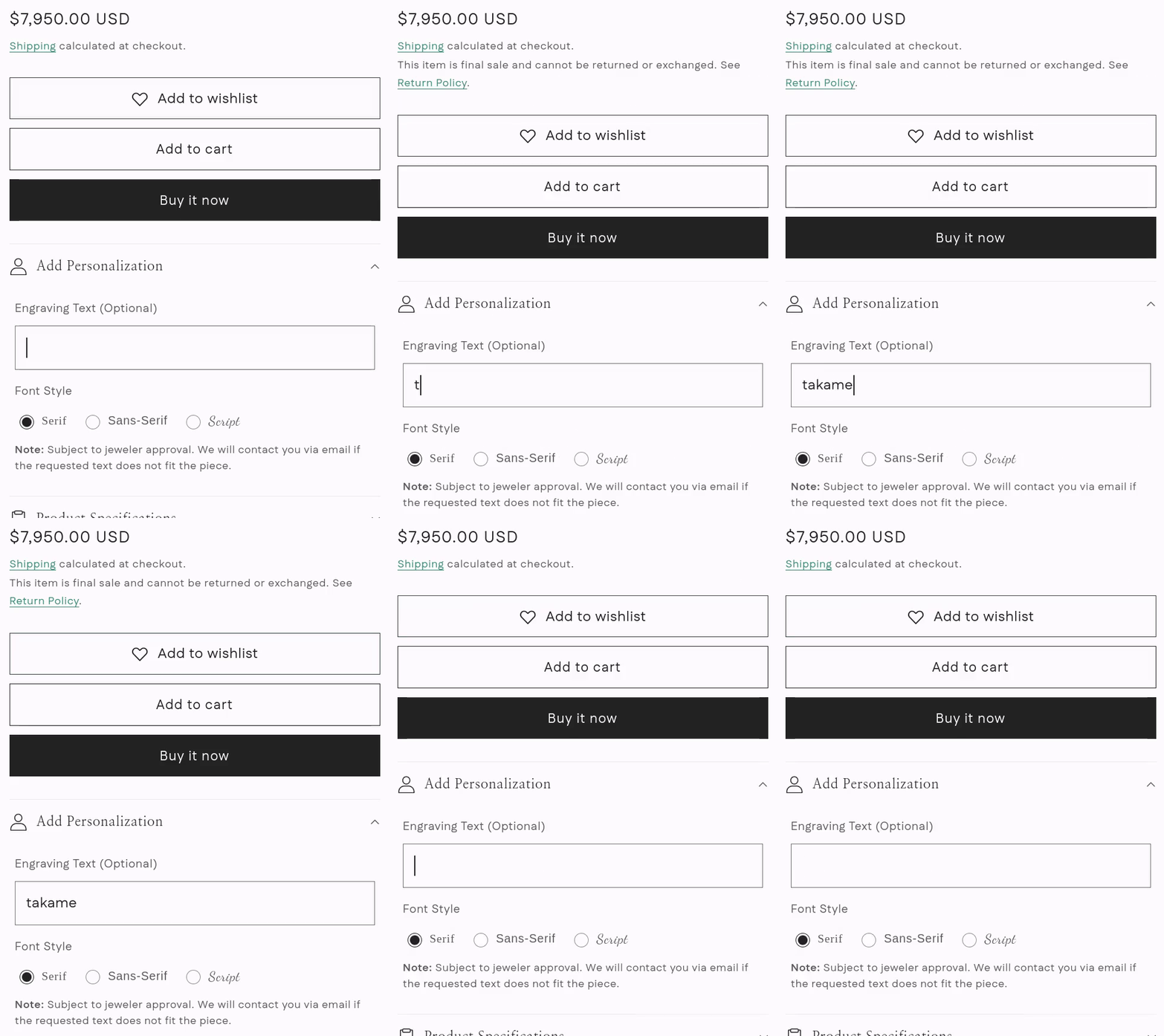
The same logic extends to the cart. If any item is final sale — by tag or by having an engraving property — a notice appears above the checkout button. The notice needed to update dynamically as customers modified their cart, which required solving a specific Shopify AJAX rendering problem: placing the notice inside the exact DOM elements that Shopify re-renders on cart changes, so removing the last final sale item wouldn’t leave a stale warning on screen.
The disclosure shows up only when it has to — and disappears the moment it doesn’t.
The Handoff
The handoff is only as good as the documentation behind it. The store operations guide runs 30+ pages — a pre-launch checklist (domain connection, UPS carrier setup, email placeholders), order fulfillment pipelines for each product type, return processing with eligibility checks, the full custom order workflow from inquiry through final payment, and a day-to-day Shopify admin reference. Every step was verified against the live Shopify admin during development, not against platform docs that may be one update behind. The return checklist mirrors the published policy exactly.

Technical Approach
A luxury site that loads slowly isn’t luxury — it’s friction. The site runs on a forked version of Shopify’s Dawn theme, chosen for its performance baseline and Shopify 2.0 architecture. The customization was extensive — custom Liquid sections for parallax CTAs, testimonial carousels, inquiry forms, grid layouts, and a mega menu with a featured product or collection slot the founders can swap from the theme editor — but it builds on Dawn’s patterns rather than fighting them. Each section loads only the CSS it needs, and there’s no build step — no bundler, no package.json, no pipeline to maintain.
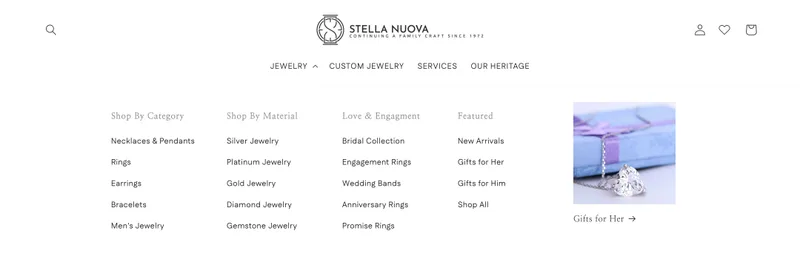
The visual language is built on restraint. A deep emerald green, the brand’s signature color, anchors the palette against black and white. Typography leans on high-contrast serif headings over clean sans-serif body text. Product pages use generous whitespace and expandable accordions to keep the layout minimal while making specifications accessible. The overall effect is closer to a brand editorial than a shopping cart — closer to Cartier’s site than Amazon’s.
All color, typography, and spacing values flow from theme settings through CSS custom properties. This means the founders can adjust the visual system through Shopify’s Theme Editor without touching code — the emerald, the type scale, the section spacing are all levers they can pull without a developer.
Outcomes
The site was functionally complete and ready for client review 15 days after kickoff. The months that followed were spent on revision cycles — integrating client feedback, translating brick-and-mortar policies into e-commerce language, and building the operational tooling for self-sufficient ownership.
What the work made possible:
- A concierge workflow for custom jewelry — inquiries arrive structured (budget, metals, stones, timeline, inspiration) and convert to Draft Order invoices. No public configurator to build or maintain, and the founders stay personally involved in every commission.
- Three purchasing models on one storefront — ready-to-wear, chain-by-the-inch, and bespoke custom each carry their own checkout logic, disclosure surface, and product-page treatment, without asking customers to learn three different mental models.
- A policy suite that matches both the platform and the law — return windows, repair abandonment, NSF fees, and tax treatment all rewritten against Florida statutes, with the cart-level final-sale disclosure rendering dynamically based on what’s actually in the cart.
- A 30+ page operations guide written against the live platform — every Shopify admin instruction (domain connection, carrier setup, return processing, custom order workflow) verified during development, not assumed from documentation.
What I’m tracking post-launch:
- Whether the custom inquiry form generates qualified leads — structured fields (budget, metals, stones, timeline) vs. open-ended “tell us about your vision” forms should produce higher-signal submissions that the founders can act on without back-and-forth
- First custom order closed through the concierge workflow — from inquiry form submission through Draft Order invoice to completed payment
Five decades of family jewelry heritage, translated into a storefront that feels like walking into the real thing — and a handoff that means the founders can run it themselves.